
AI Summary
Compare AI website builders and professional web design. Learn costs, SEO impact, and which option is best for your business in 2025.
AI Website Builders vs Traditional Web Design: Which Should You Choose in 2025?
Introduction: The Decision That'll Define Your Digital Presence
You're standing at a crossroads. You need a website. Maybe yesterday. And you're wondering: do I throw money at a web designer, or do I let artificial intelligence handle it for me?
Look, this isn't a simple answer. And anyone who tells you it is - they're either selling you something or they haven't actually built websites in the real world.
The truth? Both approaches work. Just not for the same reasons. Not for the same people. And definitely not for the same results.
In 2025, we're living through a genuine shift in how websites get built. AI image generators like ChatGPT (GPT-4o), Midjourney, and Adobe Firefly aren't just side projects anymore - they're reshaping the entire web design landscape. Tools like Freepik AI Image Generator and Nano Banana have made it possible for someone with zero design skills to generate visuals that look professional. But here's the catch: looking professional and *being* effective are two entirely different things.
So what's the real difference between letting AI build your website and hiring someone who actually knows what they're doing? Let me break it down for you, because the answer will determine whether your website becomes a business asset or a digital liability.
Understanding AI Website Builders in 2025: What They Actually Do
How AI Builders Generate Design, Layout, and Content
AI website builders work through a deceptively simple process. You feed them information - your business type, industry, a few preferences - and they spit out a complete website. In seconds. Sometimes minutes if they're feeling chatty.
Here's what's happening under the hood: these tools use machine learning models trained on millions of existing websites. They identify patterns. They recognize what works for a fitness studio versus an accounting firm. Then they remix those patterns based on your input.
The image generation side has gotten particularly sophisticated. Tools like Adobe Firefly and ChatGPT (DALL·E 3) can generate hero images, product mockups, and lifestyle photography that would've cost you hundreds a decade ago. Ideogram specializes in accurate text within images. Flux AI offers highly customizable outputs. Even Gemini Flash 2.5 Image (the one everyone calls Nano Banana for reasons I'll never understand) generates realistic images for free with limitations.
But here's the reality: AI is generating *average*. It's generating what works on average. It's not generating what's uniquely right for your specific business.
Key Features Offered by Top AI Builders in 2025
The current generation of AI website builders comes loaded with features that would've been luxury add-ons five years ago. You get templates. You get automatic layout generation. You get content suggestions. You get image generation baked right in.
Freepik AI Image Generator stands out because it bundles multiple models - Flux, Gemini Flash, Ideogram, ChatGPT, even Runway - into one subscription. This is genuinely valuable. You're not stuck with one model's limitations; you can switch based on what you need.
Adobe Firefly integrates directly into Photoshop and other Adobe apps, which matters if you're already in that ecosystem. You can generate background variations, edit elements, and upscale images without leaving your workflow.
The speed is undeniable. We're talking launch-ready websites in hours, not weeks. That's powerful for the right use case.
Who AI Website Builders Are Ideal For (And Who They Absolutely Aren't)
AI builders are phenomenal for specific scenarios. If you're a solopreneur who needs a quick online presence - a consultant launching their first site, a freelancer building a portfolio, a small service business that needs something up and running yesterday - AI can work.
They're also solid for MVPs (minimum viable products). You want to test a business idea without sinking $5,000 into design first? Build an AI site. Validate the concept. Then invest in something better if the market responds.
But here's who shouldn't touch AI builders: anyone whose website is actually a business-critical tool. If your website generates leads, makes sales, or directly impacts revenue - you need something better. You need strategy. You need optimization. You need someone who understands conversion psychology, not just layout patterns.
Limitations and Accuracy Issues of Automated AI-Generated Designs
AI website builders have serious blind spots. They don't understand your brand. They don't know why you're different from your competitors. They can't make the strategic decisions that separate mediocre websites from ones that actually move the needle.
Nano Banana, despite being excellent at image editing, has "hit and miss" prompt adherence. Adobe Firefly isn't particularly strong as a pure text-to-image model on its own - it needs the context of the editing environment to shine. Ideogram generates accurate text, sure, but even that's still inferior to a designer who understands typography and hierarchy.
The real problem? AI generates what's safe. What's average. What's already been done a thousand times. If your competitors are also using AI builders, you're all shipping the same generic experience, just with different company names plugged in.
Plus, there's the image quality issue. Krea AI (launched in June 2025) focuses on "highly realistic images with vibrant colors and photoreal skin," but even that level of sophistication can't replace professional photography that actually captures your product or service in its best light.
What Traditional Web Design Offers That AI Still Can't Replace
Fully Custom Design, Branding, and Creative Direction
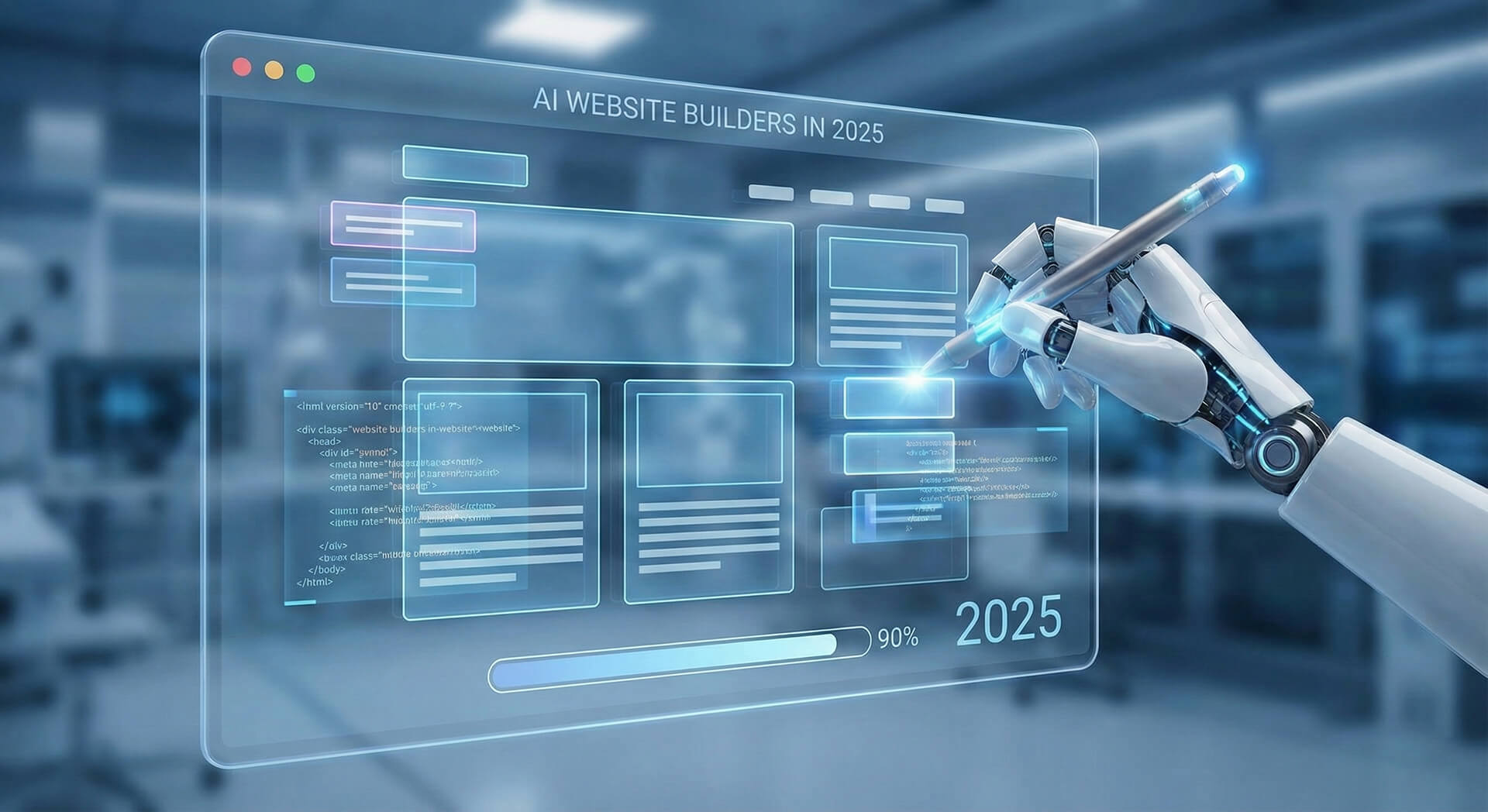
A real designer - whether solo or as part of an agency - does something AI fundamentally cannot: they think about your business strategy first, then they design around it.
They ask questions. Why are you different? Who's your actual customer, and what problem do you solve for them? What does success look like for your website? What action do you want visitors to take?
Then they build design systems that reinforce those answers. Color choice becomes strategic. Typography becomes part of your voice. Layout becomes a tool for guiding attention. Nothing is accidental.
AI can't do this because AI doesn't understand strategy. It understands patterns. Big difference.
Advanced Functionality and Integrations Beyond Builder Capabilities
You know what's expensive to implement in an AI website builder? Custom functionality. A complex e-commerce system with multiple fulfillment channels. A membership platform with gatekeeping logic. Custom integrations with your existing business software stack.
A human developer can build these things. They understand APIs. They can write custom code. They can make your website talk to your CRM, your payment processor, your inventory system - whatever you need.
AI website builders are stuck with what's pre-built. You can use what's available, but customizing beyond that gets difficult fast. And if you need something nobody's thought to build yet? You're out of luck.
Strategic UX Decisions Made by Human Expertise
User experience isn't just about pretty layouts. It's about psychology. It's about understanding friction points. It's about testing and iteration based on actual human behavior.
A good designer runs tests. They watch how real users navigate the site. They identify where people get confused. They test different button placements, different copy, different visual hierarchies. They make changes based on data, not assumptions.
AI generates a single path forward. A designer creates the infrastructure for continuous improvement.
When Hiring a Designer or Agency Gives Significantly Better Outcomes
The real question isn't whether AI or traditional design is better in the abstract. It's when does the investment in human expertise actually pay off?
If your website generates revenue - through sales, leads, bookings, subscriptions - hiring a designer almost always pays for itself. We're talking about the difference between a 2% conversion rate and a 4% conversion rate. On a $100,000 revenue goal, that's the difference between $2,000 and $4,000 in conversions. The designer probably cost you $3,000-$5,000. That's break-even on the first month of real traffic.
The longer you operate the site, the more that investment compounds. You have a strategic asset instead of a digital brochure.
Cost, Speed, and Workflow Comparison: The Numbers That Matter
Upfront and Long-Term Costs: AI Builders vs Web Designers
Let's talk money, because this is where a lot of people make their decision.
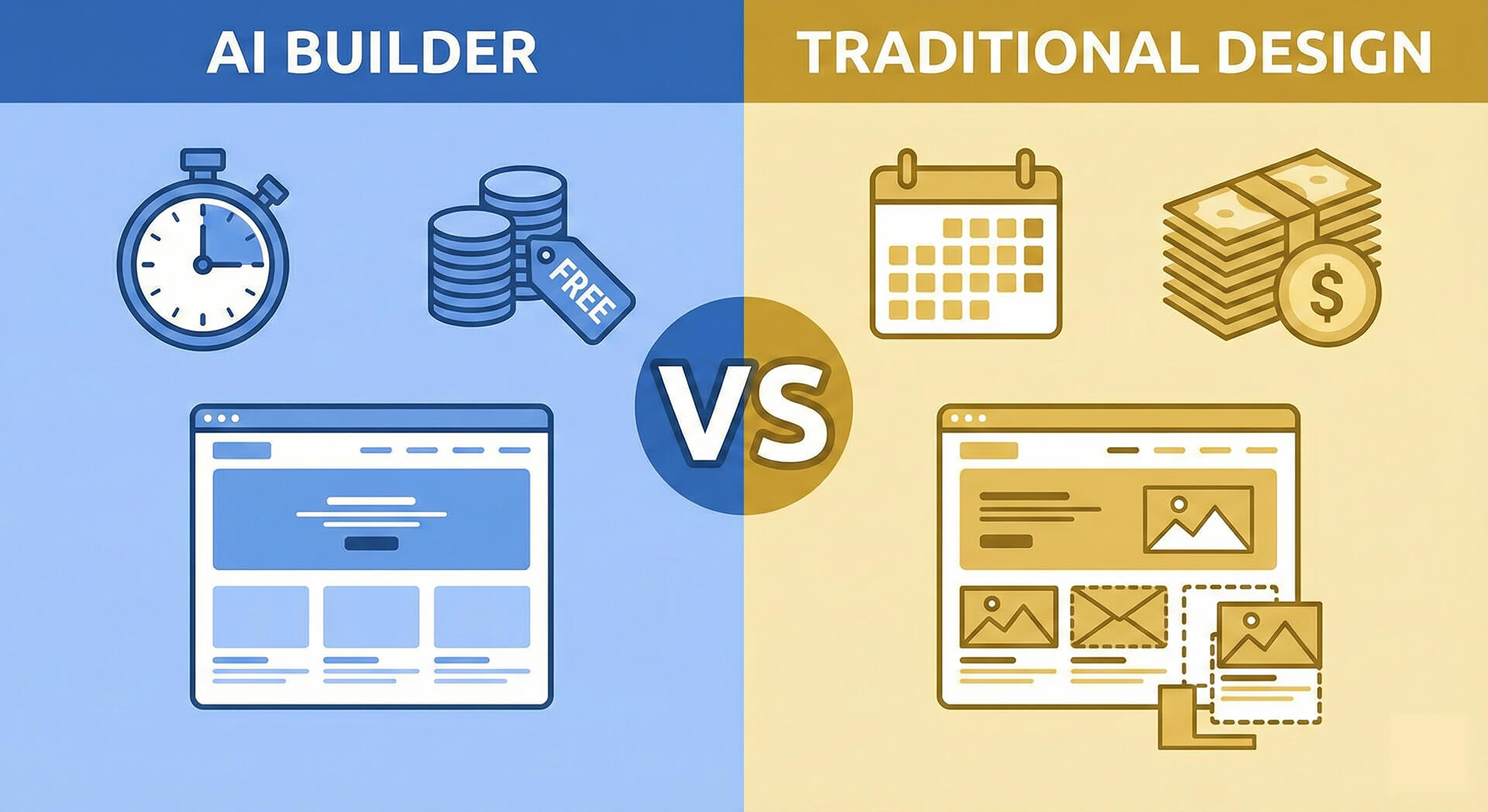
AI website builders cost almost nothing. Nano Banana (Gemini 2.5 Flash) offers limited free options and works through Google Gemini. ChatGPT Plus is $20/month and includes image generation. Adobe Firefly gives you 100 monthly generative credits for free. Ideogram offers 10 daily credits free. These tools are effectively free for light use, or cost less than $30/month if you go all-in.
A professional web designer? You're looking at $2,000 to $10,000+ for a basic site. An agency? $10,000 to $50,000+ isn't unusual, especially if you need custom functionality.
But here's what matters: that's the upfront cost. The long-term cost is where things get interesting.
An AI-built site needs maintenance. You'll probably want to iterate on it, improve it, add features. If you don't know how to do that yourself, you're hiring someone anyway. Now you're paying both the AI tool subscription *and* the designer's hourly rate. Suddenly that "free" tool isn't so free.
A professionally-designed site can often run for years with minimal maintenance. The designer built it right the first time. They optimized it. They thought through edge cases. You're not constantly fighting with the platform to make it do what you need.
Time to Launch: Automated Generation vs Manual Development
AI wins here. Decisively. You can have a website live in hours. A designer is going to take weeks or months. Discovery, design, development, testing, revisions, more testing.
But speed isn't always better. A site built in 8 hours might take 8 months to generate meaningful results. A site built in 8 weeks might generate results immediately because it was built with strategy in mind.
Maintenance Cost and Ongoing Updates
This is where AI builders start to crumble for growing businesses. You built your AI site. It's live. Now you need to add a blog. Update your team page. Launch a new service. Change your pricing.
Some of this is easy in AI builders. Some of it requires you to dive into the backend and figure things out. As your needs grow, AI builders start feeling like constraints rather than enablers.
A professionally-built site using something like a modern CMS gives you flexibility for years. The structure is solid enough to support growth. The tooling is powerful enough for someone on your team to make basic updates without calling the designer back.
Workflow Differences: Instant AI Setup vs Iterative Design Process
AI is instant gratification. Design is the opposite. It's slow. It's messy. It involves multiple revisions, feedback rounds, disagreements about color choices.
But that process exists for a reason. Constraints force clarity. Iteration surfaces better solutions. The messy process is what separates good work from mediocre work.
With AI, you get instant mediocrity. With a designer, you get slow excellence (hopefully).
SEO, Performance, and Technical Quality: Where It Really Matters
SEO Strengths and Weaknesses of AI Website Builders
AI website builders have gotten better at SEO basics. They'll include meta tags. They'll structure your content with heading hierarchy. They'll optimize image alt text.
But SEO isn't just technical. It's strategy. It's understanding which keywords matter for your business. It's planning content that addresses your audience's actual questions. It's building internal linking structures that reinforce your site's authority.
An AI builder can't do this. It can generate content suggestions, but those suggestions are generic. They don't reflect market research or competitive analysis or your unique positioning.
A professional can. They understand SEO as a business discipline, not just a checklist.
Performance, Core Web Vitals, and Code Quality Differences
Here's something that matters for both users and Google: how fast your site actually loads.
AI website builders often generate bloated code. Unused CSS. Unoptimized images. JavaScript libraries that could be stripped down. It works, but it's not efficient.
A professional developer can hand-optimize. They can strip out what's unnecessary. They understand performance as a feature, not an afterthought. Core Web Vitals? That's not a mystery to them. That's the foundation.
Scalability and Technical Limitations of AI-Generated Sites
What happens when your AI-built site suddenly gets 10 times the traffic? Or 100 times?
Most AI website builders can handle it - they're hosted on robust infrastructure. But the site's architecture might not scale well. The code might not be optimized. You might hit limitations on customization or integrations.
A professionally-built site is built with growth in mind. The architecture supports scaling. The code is optimized for performance at any traffic level.
How Custom-Built Websites Excel in Optimization and Long-Term Flexibility
A professional website is built to evolve. The developer structures things so that future developers can understand the code, maintain it, extend it. The design system supports new use cases. The infrastructure scales.
You're not locked into today's version of the builder platform. You're not dependent on a vendor's roadmap. You own the underlying code. You can do whatever you want with it.
Which Option Is Best for Different Use Cases?
Best Use Cases for AI Website Builders
The quick launch: You need a site online this week. An AI builder is perfect.
The MVP: You're testing a business idea. You don't know if it'll work yet. Why spend $5,000? Build it with AI first. Validate the market. Then invest in a real site if it makes sense.
The low-revenue business: You're a freelance consultant. Your website doesn't generate revenue directly. It's just a business card. An AI site is more than enough.
The portfolio: You're a creative professional and need to showcase your work. AI builders offer solid templates for portfolios. You'll supplement with real images of your projects.
The side project: You run a small side business and don't have budget for professional design. An AI builder lets you maintain professional credibility without the expense.
Best Use Cases for Traditional Web Design
Revenue-generating websites: If your website makes you money, invest in it. The ROI is almost always there.
Brand-critical businesses: If your brand is your competitive advantage, you need design that reflects that. Generic AI templates don't do that.
Complex functionality: You need custom integrations, membership systems, custom workflows, or anything beyond basic content management. You need a developer.
Highly competitive markets: If your industry is brutal and everyone's fighting for attention, you need a website that stands out. That requires strategic design, not AI templates.
Long-term assets: You're building something you'll use for years. You want the investment to compound. You want infrastructure that supports that.
Decision Matrix Based on Budget, Timeline, and Technical Needs
Here's how to think about it:
Budget under $500, timeline under 2 weeks, basic website: AI builder. This is what they're built for.
Budget $500-$3,000, timeline flexible, some revenue generation: Could go either way. If you have specific brand requirements or custom functionality, hire someone. If you're okay with templates, AI works.
Budget $3,000+, timeline flexible, revenue-critical: Hire a professional. The ROI calculation works in your favor.
Budget flexible, timeline critical, any complexity: Hybrid approach. AI builder for the draft, professional to refine it. We'll talk about this below.
Examples of Real-World Scenarios for Each Choice
AI builder scenario: Sarah is a yoga instructor opening her first studio. She needs a website showing class times, location, and booking info. She has $200 budget and needs it live in 2 weeks. AI builder is perfect.
Professional design scenario: Mike runs an e-commerce company doing $500K annual revenue. His website generates 40% of his sales. He wants to optimize conversion rates and scale the platform. He invests $15,000 in a custom-built, optimized site. The conversion rate lifts to 4.2% from 3.8%. That's an extra $2,000/month in revenue. He breaks even in 7 months.
How to Choose the Right Approach in 2025
Hybrid Model: Using AI for Draft Generation and Designers for Refinement
Here's my favorite approach, and I think it's the future: let AI do the heavy lifting, then have a professional refine it.
You start with an AI builder. Generate a complete site in a few hours. Get something you can look at. Something tangible. Get the basic structure, layout, content framework.
Then you hand it to a designer or developer who says, "Here's what works, here's what doesn't. Here's what we need to change for your brand. Here's where we need custom functionality."
You save 40% of the development cost because the designer isn't starting from scratch. You maintain quality because a professional is involved. You get the best of both worlds.
This is particularly valuable with image generation tools like ChatGPT (GPT-4o), Midjourney, and Adobe Firefly. Generate initial image concepts using these tools. Refine them with a designer who understands composition, lighting, and your brand.
Questions to Ask Before Choosing AI or Traditional Design
Before you decide, answer these honestly:
- Does my website generate revenue, leads, or bookings directly?
- Do I have custom functionality or integration needs?
- Is my brand a significant part of my competitive advantage?
- Will I need to scale this website significantly in the next 2 years?
- Do I have budget for professional design?
- Do I have time to iterate and improve an AI-built site myself?
- Is my industry highly competitive and design-sensitive?
If you answered "yes" to 3+ questions, hire a professional. If you answered "no" to 4+ questions, AI is probably fine.
Future-Proofing Your Website for AI and Upcoming Trends
Here's the thing about AI in web design: it's going to get better. Faster. Cheaper. In 2 years, AI will generate websites that look and function better than what we can build today.
If you build an AI site now, you'll probably need to rebuild it in a few years as AI improves. That's fine. It's cheap to rebuild.
If you build a professional site now, make sure it's built with modern tools and architecture. Make sure the code is clean enough that a future developer can update it. Make sure the design system is flexible enough to evolve.
Final Guidance for Selecting the Best Option Based on Goals
Here's my honest take: most people underestimate how much a good website is worth, and overestimate the time savings of an AI builder.
If your website is just decoration, AI is fine. Build it, forget about it.
If your website is a business tool, invest in it properly. Get a professional involved. The ROI will surprise you.
And if you're somewhere in the middle? Try the hybrid approach. Use AI to de-risk the decision. See if professional design actually makes a difference for your specific situation. Then you'll have actual data instead of opinions.
Conclusion: Making the Decision That's Right for Your Business
The question isn't really "AI or professional designer?" It's "what does my business actually need?"
AI website builders are genuinely useful tools. They've democratized website creation. They've eliminated the barrier to entry for solo creators and small businesses. That's valuable.
But they're tools for specific jobs. Quick launches. MVPs. Low-stakes projects. Simple portfolios.
Professional web design is for everything else. For businesses where the website matters. Where it needs to be different. Where it needs to perform.
The good news? You don't have to choose one path forever. You can start with AI. See how it goes. If the website actually matters to your business, then invest in professional help.
What you shouldn't do is assume AI is "good enough." Good enough for what? If it's good enough for your specific goals, great. If it's not, you just wasted 8 hours iterating on something that was never going to work.
Be honest about your goals. Be honest about your budget. Be honest about how much your website matters. Then make the decision that aligns with reality, not wishful thinking.
And if you're serious about your website, talk to a professional. Get a few quotes. See what you actually need versus what you think you need. Make an informed decision based on facts, not fear.
Your website is one of your most important business assets. Treat it that way.

0 Comment(s)
Be the first to leave a comment!