
AI Summary
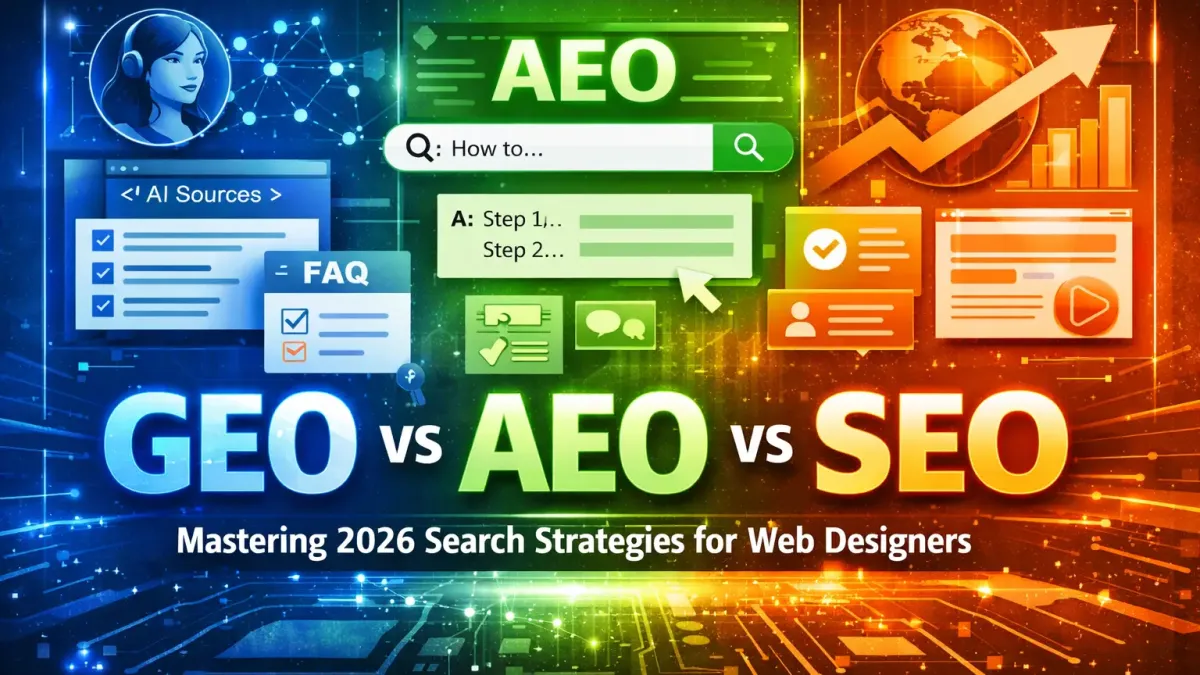
Master GEO, AEO, and SEO in 2026. A guide for designers to survive zero-click search & win AI citations. Includes a new visual comparison framework.
I'm going to tell you something you already know, but maybe haven't fully accepted: the internet is broken, or at least, the way we use it to find stuff is.
For years, our job as web designers and strategists was simple: build a great site, get that coveted blue link at the top of Google, and watch the traffic pour in. That was SEO. But now? Now the search engine often doesn't want the user to click at all. It just gives them the answer right there. That's the zero-click world we live in.
This massive shift means traditional SEO is no longer enough to keep your clients visible. We need to think in layers. We need to optimize for answers (AEO) and we absolutely need to optimize for AI citation (GEO). And web designers? We are suddenly at the front lines of this strategy. We design the structure the AI systems read. If we mess it up, the site becomes invisible.
This guide is your practical framework for designing websites that win across all three major search strategies in 2026 and beyond.
The 2026 Search Landscape: Why SEO Alone Is No Longer Enough
Remember when your biggest worry was page load time? Bless those simpler days. Site performance still matters, sure, but the biggest hurdle today isn't speed - it's invisibility. We're fighting a battle against the AI taking our clicks.
Web designers used to focus purely on the human experience and the aesthetic layout. Now, you are a crucial part of the search strategy team because you decide how content is structured, how the code is served, and what the AI can actually read. If you're not thinking about schema and content hierarchy, you're failing the site's search potential.
From Ranking Pages to Being Cited as Sources
The whole game has changed. We used to strive to rank Page A at Position 1. Now, we strive to be the source that Google's AI Overview or a chatbot like ChatGPT quotes when answering a complex question. This means the goal isn't just getting the user to click; the goal is getting the machine to trust your site enough to use your facts.
Source (AI Overviews Trend): Semrush – AI Overviews Study (SERP impact and visibility changes)
This trust is what we call citation. And without it, even a beautiful, fast website might just disappear from relevance as users get their answers directly inside the search box or a generative chatbot.
The Rise of Zero-Click Searches and Synthesized Answers
Most search queries today end without a click to an external website. This is what we call the zero-click phenomenon. It happens because Google gives you the perfect featured snippet, or the AI Overview delivers a four-paragraph summary right at the top. When users get what they need without clicking, our traffic suffers.
Sources (Zero-Click Trend): Search Engine Land – Zero-click searches up, organic clicks down | Click-Vision – Zero-Click Search Statistics
But we can flip the script. If you understand how AI overviews and answer engines gather their data - which is usually pulled from 2 to 4 high-authority, well-structured sources - you can design your content to be one of those chosen few. That's the difference between being ignored and being synthesized.
What Is SEO in 2026? The New Baseline for Visibility
Let's be clear: SEO isn't dead. It's just the entry ticket. Traditional Search Engine Optimization still provides the foundation that allows the other strategies to work. If Google can't crawl your site, index your pages, and trust your domain, AEO and GEO won't even matter.
Core Web Vitals and Performance Expectations in 2026
Web Vitals are still extremely important, perhaps more so now that mobile-first indexing is standard. You need great Largest Contentful Paint (LCP), Interaction to Next Paint (INP), and Cumulative Layout Shift (CLS). If your site is sluggish or jumps around during loading, you lose trust signals immediately, and that hurts all three optimization styles.
The speed of the site tells the search engine, "This is a good experience." We must design for maximum performance from the first layout and interaction.
Topical Authority and Internal Linking Structures
Today's SEO doesn't just care about keywords anymore; it cares about expertise. Do you cover a topic deeply? Do you have authority? Web designers need to create site architectures that support this. We call this topic clustering. Instead of just throwing up random blog posts, you group them logically - a main pillar page linking out to a dozen supporting articles.
This structure proves to the search engine that you are the expert in that specific area, earning you higher authority and relevance.
Technical SEO Foundations Web Designers Must Get Right
The basics remain the basics for a reason. Web designers must ensure clean HTML, proper use of heading tags (H1, H2, H3), and descriptive meta titles and descriptions. These are the fundamental instructions the machine uses to read your page. And don't forget image alt text - it's crucial for accessibility and understanding.
What Is AEO (Answer Engine Optimization)?
AEO is the direct effort to win the "Position Zero" snippets, the PAA (People Also Ask) boxes, and voice search answers. This is optimizing specifically for immediate, short answers to common questions.
Deep Dive: If you want to master the specific tools and schema required for this strategy, read my full guide on AEO Strategy 2026: Beyond SEO to Answer Engine Optimization.
Writing Content Optimized for Question-Based Intent
When someone searches, they usually have a question. AEO makes sure your content gives a clean, direct answer to that specific question. Web designers need to encourage clients to format their content in an answer-first way. Think about designing FAQ pages, or structuring core content with H3 questions that are immediately followed by concise, 40-60 word answers.
This short burst of text is exactly what Google looks for when generating a featured snippet.
FAQ, HowTo, and Schema Strategies for AEO
Structured data, or schema markup, is your secret weapon here. When you use FAQPage schema or HowTo schema, you are literally telling the search engine, "Hey, this content is structured as a question-and-answer resource." This increases the chance of winning a snippet dramatically.
- FAQ Schema: Perfect for pages answering a set of specific questions.
- HowTo Schema: Great for step-by-step guides and tutorials.
- Voice Search Headings: Use natural language questions as headings (e.g., "How do I choose the right color palette?").
How Answer Engines Select and Synthesize Responses
Answer engines look for the highest quality, most concise answer immediately following a common question. They prefer lists, short paragraphs, and tables. Your job as the designer is to make sure those answer blocks are visually distinct and easy for the AI to parse, separated by strong, clear headings.
What Is GEO (Generative Engine Optimization)?
GEO is the new frontier. This is all about preparing your content to be trusted and cited by platforms like ChatGPT, Gemini, and Perplexity. These AI systems train on massive datasets, and your goal is to ensure your domain is seen as an authoritative part of that training data.
Optimizing Content for AI Citations and Brand Mentions
GEO isn't about driving clicks today; it's about future-proofing your brand. When a user asks a complicated question of an AI chatbot, you want your site to be one of the sources the bot uses to generate its complex response. If you get cited, your brand is positioned as a subject matter expert, which drives reputation and long-term search success.
This means your content needs to be fact-rich, statistically sound, and comprehensive. Generative AI systems value information gain - they want something new and valuable.
Brand, Author, and Entity Signals that Influence GEO
This is where EEAT (Experience, Expertise, Authoritativeness, Trustworthiness) comes into play hard. For GEO, the machine needs to know who wrote the content and why they should be trusted. Web designers need to implement prominent, high-quality author bios, link those authors to social profiles, and include clear publication and update dates.
These signals convince the generative AI that the human behind the facts is credible, making the facts more likely to be used.
How Generative Engines Source and Cite Information
Generative engines look for topical authority and factual accuracy. They prioritize well-structured content that clearly defines entities (people, places, things). If your content is vague or poorly cited internally, the AI won't bother using it. You need clean, machine-readable data presented in a conversational structure that mirrors how humans ask complex questions.
GEO vs AEO vs SEO: Key Differences Web Designers Must Understand
These three strategies work together, but their immediate goals and target audiences are completely different. Thinking of them as separate stages helps you prioritize your design decisions.
Visual Framework: SEO vs AEO vs GEO (2026)
| Factor | SEO (Search Engine Optimization) | AEO (Answer Engine Optimization) | GEO (Generative Engine Optimization) |
|---|---|---|---|
| Primary Goal | Rank pages in organic results and earn clicks | Win direct answers (snippets, PAA, voice) | Get cited/used as a trusted source in AI-generated answers |
| Where You Appear | Google SERP “blue links”, images, video, local packs | Featured Snippets, People Also Ask, instant answers | AI Overviews + AI chat tools (ChatGPT/Gemini/Perplexity-style) |
| Main Success Metric | Rankings, impressions, organic traffic, CTR | Snippet wins, PAA visibility, impressions, assisted conversions | Citation frequency, brand mentions, “source visibility” |
| Search Intent Focus | Broad: informational, commercial, transactional | Question-based intent (“what/how/why”) | Complex intent (“compare, recommend, explain deeply”) |
| Best Content Formats | Pillar pages, landing pages, service pages, blogs | FAQ sections, Q&A blocks, definitions, step-by-step answers | Deep comparisons, frameworks, research-backed guides |
| Ideal Answer Length | Full coverage (800–2500+ words depending on topic) | Short, direct answers (40–60 words), lists, tables | Fact-rich sections + structured summaries AI can quote |
| Content Structure | Topic clusters, internal links, strong H1/H2 hierarchy | Question headings (H3), answer-first blocks, scannable layout | Clear entities, definitions, evidence blocks, “quote-ready” sections |
| Technical Requirements | Crawlability, indexing, CWV, mobile-first, clean HTML | Clean headings, schema support, readable answer blocks | EEAT signals, schema, author identity, references |
| Structured Data Priority | Organization, WebSite, Breadcrumb, Article, Product | FAQPage, HowTo, QAPage (when relevant) | Article + Author + Organization + sameAs + entity support |
| Trust Signals Needed | HTTPS, quality backlinks, topical authority | Accuracy, clarity, consistent answers | Author credibility, sources, original insights |
| Biggest Risk | High competition and slow ranking results | Zero-click can reduce traffic even when you “win” | Harder to measure; requires credibility + originality |
| Best Use Case | Long-term stable growth and consistent traffic | Fast visibility for common questions and “Position Zero” | Future-proof authority + becoming a referenced source in AI answers |
| Best Strategy | Build pages to rank | Build answers to be extracted | Build knowledge to be cited and trusted |
Where Overlap Exists and Where Strategies Diverge
The overlap is simple: **Technical Cleanliness.** All three require a fast, mobile-friendly, crawlable website with proper basic SEO structure (headings, titles, clean code). You must have this foundation.
But they diverge on outcomes:
- SEO Goal: To rank the blue link and drive click-through traffic (CTR).
- AEO Goal: To win Position Zero and deliver direct answers, optimizing for impression share.
- GEO Goal: To be cited and synthesized by large language models, optimizing for citation frequency and brand visibility within AI output.
Content Formats Best Suited for Each Strategy
For SEO, long-form guides and detailed product pages work well. For AEO, you need those short, punchy FAQ formats and clearly defined steps. For GEO, you need comprehensive, highly researched, authoritative deep dives - the kind of reports that are too long for a snippet but perfect for an AI to pull five facts from.
How Web Designers Can Implement SEO, AEO, and GEO Together
You shouldn't choose one. You must build a unified, layered strategy right into the design and content architecture.
Aligning UX, Content, and Search Strategy
When designing a page, think of the user journey in three parts. The top of the page should answer the immediate question (AEO). The middle should provide detailed context and authority (SEO). The bottom should provide deep, structured facts and sources (GEO).
Don't hide your answers in paragraphs of fluffy text. Design layouts that make answers pop out visually - using boxes, tables, or highlighted text blocks that are clearly marked with H3 questions.
Schema, Structured Data, and Entity Optimization
This is the most actionable step for a web designer. We need to go beyond basic organizational schema. You should be using entity recognition - marking up who your authors are, what your brand is, and the core subjects of your content using sophisticated structured data formats like JSON-LD.
Use the schema that tells the machine not just *what* the page is about, but *who* wrote it and *why* it should be trusted.
Designing Site Architecture for Topical Authority
Ditch the flat site structures. Adopt the pillar and cluster model. Design your navigation and internal linking to heavily reinforce topic clusters. This means every supporting article links back to the main topic pillar. This structured approach is what search engines and AI models love, as it maps knowledge clearly and proves your comprehensive authority on a subject.
Future-Proof Search Strategy Checklist for Web Designers (2026 and Beyond)
The job description for web design has changed. We are no longer just visual artists; we are information architects who translate human knowledge into machine-readable structure.
Measuring Success Beyond Traditional Rankings
Stop obsessing over Position 4. Start asking your analytics team to track visibility metrics: How often are we winning the featured snippet? How often is our brand cited in an AI overview? These are the real metrics of the 2026 search landscape. Clicks are great, but sustained relevance in the AI ecosystem is invaluable.
Common Mistakes to Avoid in AI-First Search Optimization
The biggest mistake? Treating generative AI like old keyword stuffing. You can't trick the AI by repeating words. Generative systems are sophisticated. Focus on natural language, conversational context, and above all, unique and verifiable facts.
SEO, AEO, and GEO Implementation Checklist
- Foundation (SEO): Check Core Web Vitals, ensure lightning-fast mobile performance, and audit internal linking weekly.
- Answer Layer (AEO): Format content into clear H3 questions followed by 50-word answer boxes; deploy FAQ/HowTo schema on relevant pages.
- Trust Layer (GEO): Implement detailed author EEAT signals; ensure every factual claim has supporting evidence or a reference; optimize for clear entity definitions.
The future of search isn't coming; it's here. By adopting a layered approach that integrates SEO fundamentals, AEO answer optimization, and GEO brand visibility, you ensure the websites you design remain visible and relevant, whether the user clicks a link or asks an AI assistant for advice.



0 Comment(s)
Be the first to leave a comment!