
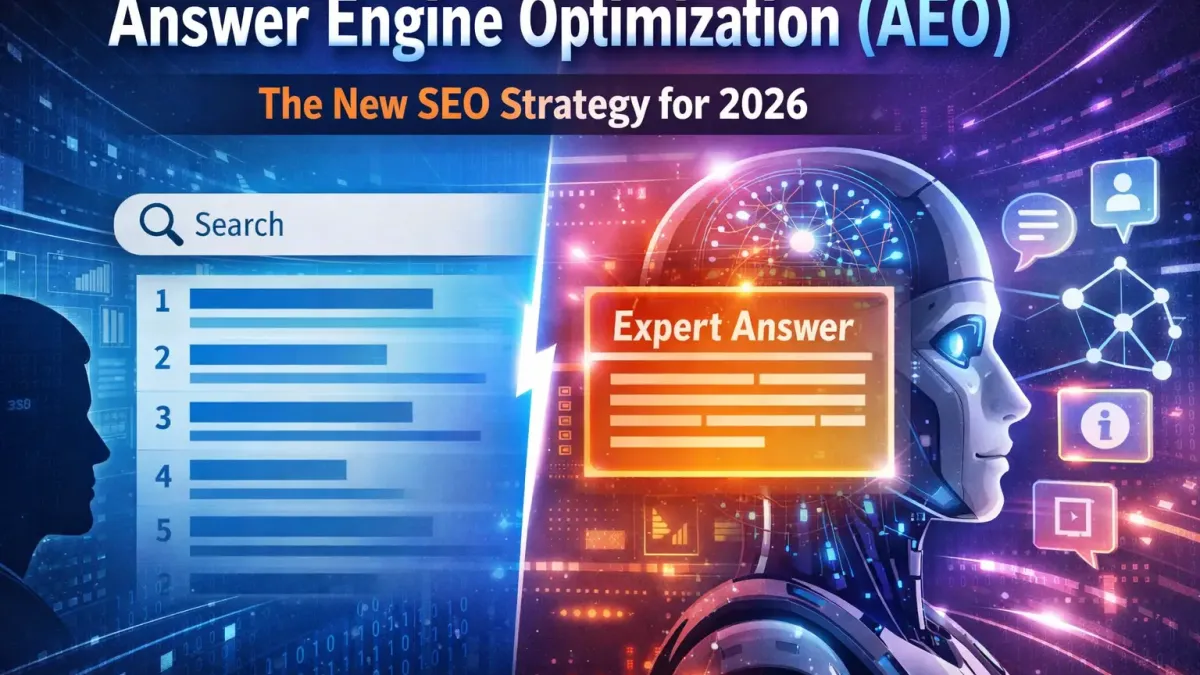
AI Summary
Master AEO in 2026 Learn how to optimize content for AI Overviews, ChatGPT, and Perplexity using E-E-A-T and structured data to win zero-click results
I'm going to tell you something harsh: The organic search traffic you worked tirelessly to build over the last decade? It's about to vanish. Not because your content is bad, but because the internet has fundamentally changed. We aren't searching anymore. We are asking.
For too long, we accepted the tyranny of the "10 blue links." Your goal was simple: get to position one. But when a user asks ChatGPT, Perplexity, or Google's new AI Overviews a question, they don't get a ranked list of links. They get one synthesized, authoritative answer. Zero clicks. Your brand is either the cited source in that answer - or you don't exist.
This is why SEO, as we know it, is dead. In its place rises Answer Engine Optimization (AEO). AEO is the competitive advantage you need right now to survive the shift into 2026. This isn't just about schema markup; it's about fundamentally restructuring how your business communicates expertise to machines that are learning faster than we are.
What Is Answer Engine Optimization (AEO)?
Answer Engine Optimization (AEO) is the specialized process of creating and formatting content so that massive AI engines like Google's AI Overviews (SGE), Microsoft Copilot, Gemini, ChatGPT, and Perplexity can easily understand, extract, and surface your specific information as direct, synthesized answers to user queries.
Forget trying to rank the whole page. AEO is focused on optimizing specific content chunks - paragraphs, tables, FAQs - that can be flawlessly extracted and presented as the "source of truth." This optimization is required for success in zero-click results, featured snippets, knowledge panels, and voice responses.
The Difference Between Search Engines and Answer Engines
You have to understand the core mechanical difference between these two entities, because they value content differently.
Search Engines (Traditional Google): These were indexing machines. Their core output was a ranked list of links. Their goal was relevance. They were probabilistic in volume (how many backlinks do you have?) and deterministic in rank (you were either #1 or you weren't). They handled targeted high-traffic keywords.
Answer Engines (AI Overviews, ChatGPT, Perplexity): These are synthesis machines. Their core output is a direct, synthesized answer. Their goal is factual accuracy and comprehensive expertise. They are highly probabilistic in result generation (two users asking the same question might get slightly different answers based on context) and handle an infinite number of conversational or long-tail query variations. They prioritize user intent over simple keyword density.
AEO vs Traditional SEO: Key Shifts
The strategic priorities have completely flipped. We spent decades focusing on technical structure and link velocity. Now, the emphasis is almost entirely on quality, clarity, and authority.
- Optimization Target: SEO targeted the entire web page, focusing on keywords and backlinks. AEO targets specific, extractable content chunks.
- Output Format: SEO delivered a ranked list of links. AEO delivers direct, summarized, synthesized answers.
- Query Handling: SEO focused on 100 high-volume keywords. AEO must address thousands of conversational, long-tail, and user-specific variations.
- Core Ranking Factor: SEO relied heavily on technicals and domain authority via backlinks. AEO is obsessed with E-E-A-T (Experience, Expertise, Authoritativeness, Trustworthiness).
I can't stress the E-E-A-T shift enough. The AI doesn't trust a website just because it has links; it trusts the website because it demonstrates true, comprehensive, and up-to-date expertise on a subject. You must become the undisputed expert in your niche to survive the 2026 shakeup.
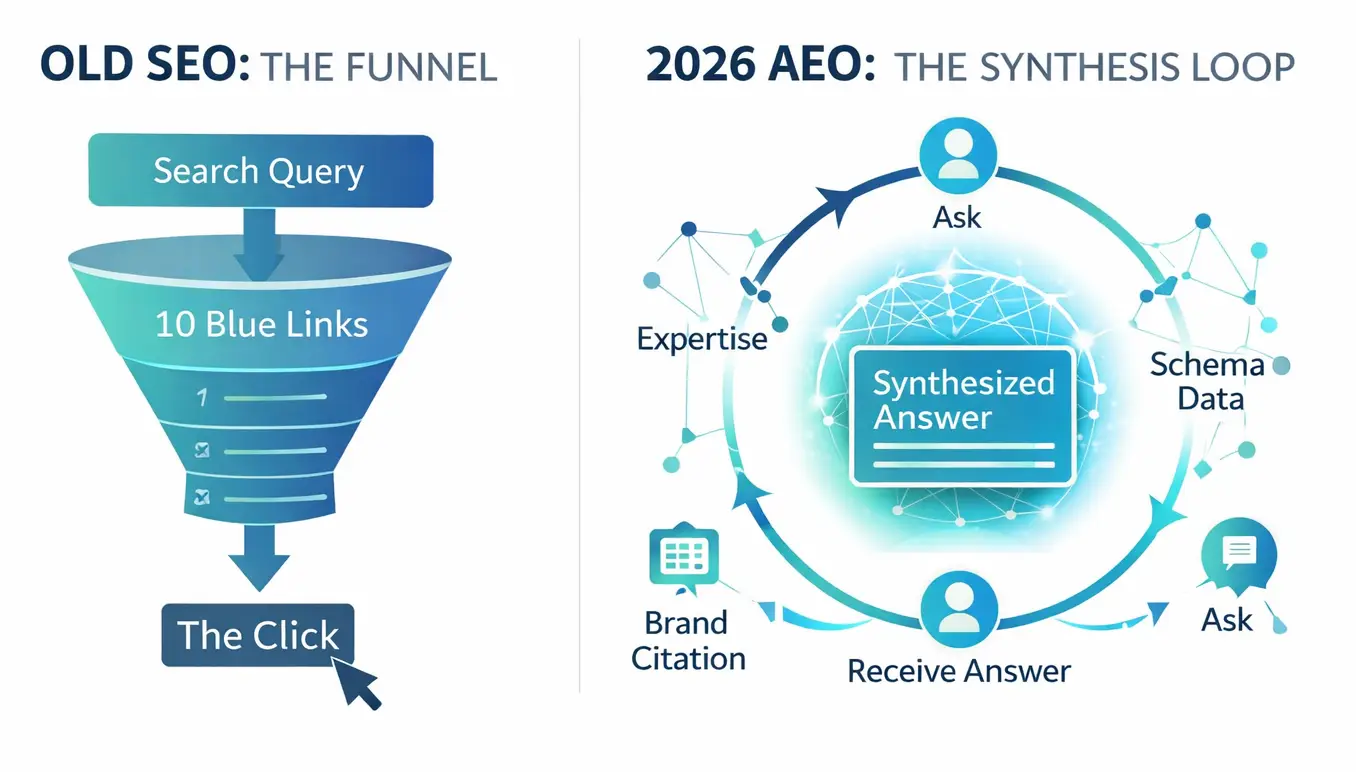
The evolution from linear search traffic to the AI-driven AEO synthesis loop.
How AI Answer Engines Work
To optimize for AEO, you must think like the AI that's crawling your site. These systems don't read your website like a person. They process, analyze, and store information in highly structured ways.
Knowledge Graphs and Structured Data in AI Search
Generative AI engines, especially those connected to major search indexes (like Google's Gemini), rely heavily on knowledge graphs. They don't just see a web page; they map entities and relationships.
When an AI crawler hits your site, it isn't just indexing H1s and alt tags. It is looking for clear, unambiguous facts that can be plugged into its existing knowledge base. If your content "Definition of AEO" is clearly structured, factual, and consistent with other authoritative sources, the AI flags it as a high-confidence entity definition.
This is why structured data, schema markup (specifically How-To, FAQ, and Comparison schemas), is so crucial. It acts as a translator, explicitly telling the AI: "This chunk of text is the answer to this question." If you don't use schema, the AI has to guess. If you do, you cut the guesswork and accelerate extraction probability.
Role of Entities, Context, and Semantic Understanding
Modern Generative AI uses sophisticated Natural Language Processing (NLP) to interpret content semantically, not just keyword-by-keyword. This means:
- Context is King: If a user asks "How much does an iPhone cost?" the AI knows the necessary context (which model, where, new or used) and pulls information based on the user's location and recent history. Your content must be broad enough to address those contextual variables.
- Entity Matching: The AI identifies key entities (e.g., "Profits", "Q3 2024", "Apple Inc.") and cross-references them. If your entity facts conflict with 10 other high-E-E-A-T sources, you lose. Accuracy isn't optional; it's mandatory.
- Generative Synthesis: Unlike old featured snippets which just extracted a paragraph verbatim, current Answer Engines synthesize. They might take sentence A from your site, sentence B from a competitor, and blend them into a new response. Your goal, therefore, is to provide the most precise, concise, and trustworthy sentence A and B possible, making your source irresistible to the synthesizer.
Core Ranking Factors for AEO
AEO doesn't have a definitive "ranking algorithm" like traditional SEO did. Instead, it relies on a set of probabilistic signals designed to gauge confidence and extractability. Ignore these at your peril.
Trust, Accuracy, and Source Credibility Signals
The single most important factor in AEO is establishing yourself as the most credible authority. If an AI Overviews answer is wrong, Google loses trust. Therefore, the AI is programmed to prioritize sources that mitigate risk.
This requires a rigorous E-E-A-T Audit.
- Demonstrable Experience (E): Do you have case studies, real-world data, and original research? Show the AI that you have actually done what you are writing about.
- Expertise (E): Is the content authored or reviewed by a recognized expert in the field? Use author bios that clearly detail credentials.
- Authoritativeness (A): Are you consistently cited by other authoritative (high E-E-A-T) sources? This is the new, targeted version of link building - it's authority building.
- Trustworthiness (T): Is your content factually correct, easily verifiable, and free of grammatical or factual errors? Tools like Schema App and Merkle help ensure technical trust, but content quality is paramount.
Structured Data, Schema, and FAQ Optimization
If you aren't using structured data, you are actively blocking AI from using your best content. Schema is the infrastructure of AEO. You need to standardize your output.
- FAQs Schema: This is a must-have for surfacing in People Also Ask boxes and as direct answers. The Question must be clearly presented as a heading or strong tag, immediately followed by the most concise answer possible.
- How-To Schema: Perfect for process-driven queries. This tells the AI: "Here are the steps, in order." AI loves numbered lists and ordered steps because they are easy to break down and explain conversationally.
- Comparison Tables: As the research notes confirm, AI engines favor comparison-driven content. If you are comparing tool A and tool B, format it as a clean HTML table. The AI can instantly extract that data for a side-by-side comparison response.
Entity-Based SEO and Topical Authority
Traditional SEO focused on keywords like "best running shoes." Entity-based SEO focuses on the entities involved: "Nike Pegasus," "running," "impact absorption," "marathon." You must build topical clusters around every entity relevant to your brand.
Topical authority means covering a subject breadth deeply and comprehensively. If you want to be cited for "Answer Engine Optimization," you must cover not just the definition, but also the tools, the strategy, the history, and the future trends. The AI needs to see that you have exhausted the topic, proving your expertise.
AEO Content Strategy for 2026
I don't want you to just retrofit old content. I want you to start designing content specifically for the AI extraction process.
Aligning Long-Tail Keywords with User Intent
In the AEO era, keywords are no longer isolated words; they are conversational prompts. You need to map real user prompts - from awareness to conversion queries - and cover them broadly.
Tools like Profound help here, showing you exactly how your brand is being cited (or not cited) across platforms like ChatGPT and Perplexity. You then reverse-engineer the successful prompts and write dedicated content blocks that directly answer them.
- Awareness Queries: Answer "What is X?" and "Why does Y happen?" with short, definitive paragraphs (under 50 words).
- Conversion Queries: Answer "How do I implement Z?" or "What are the best tools for Q?" with step-by-step guides, comparison tables, and clear calls to value (not necessarily clicks).
Content Formatting for AI Readability
The core strategy is simple: provide value in the fewest words possible. Concise language is crucial for zero-click and voice search success.
- Definitive Headings: Use clear, H2 and H3 headings that pose questions ("What is the definition of AEO?") and immediately follow with the answer.
- Lists and Bullets: Use ordered and unordered lists constantly. AI loves structured data. If you have three points, use three bullets.
- The Inverted Pyramid (AEO Style): State the conclusion/answer first, then provide supporting context. If you take 300 words to get to the main point, the AI will likely have extracted its answer from a faster source.
- Brand Integration: Make sure your brand is consistently mentioned in connection with your authoritative claim. This helps the AI connect the authoritative fact with your brand entity, increasing the probability of citation.
Optimizing FAQs and Conversational Queries
FAQs are no longer just an afterthought page. They are the backbone of your AEO strategy. Every piece of content should have an FAQ section that addresses common related questions.
We are optimizing for natural language. People don't search "AEO definition." They search "Hey Google, what should I do instead of SEO next year?" Your content needs to address that full, informal query.
Think about follow-up questions. If you answer "What is AEO?" the AI knows the next question is probably "How much does AEO cost?" or "What tools do I need?" Cover these related topics in a tightly clustered manner so the AI can pull an entire sequence of answers from your domain.
AEO vs SEO: What Changes for Marketers
This shift requires a total overhaul of your measurement strategies and cross-functional relationships within the enterprise.
New KPIs for AI-Driven Search Success
If the goal is to earn a citation without a click (a zero-click result), how do you measure success?
Traditional SEO success was measured by clicks, organic traffic, and ranking position. AEO success is measured by:
- Visibility/Share of Answer: How frequently is our brand or content cited as the source in AI Overviews, ChatGPT, Perplexity, and Copilot for our high-value queries? Tools like Profound are essential for tracking this cross-platform visibility, as scraping historical data is nearly impossible without API partnerships.
- Authority Score: Tracking E-E-A-T signals, expert author citations, and the rate at which you own the topical cluster.
- Conversion Attribution (Downstream): Because the click doesn't happen first, you track conversions that occur immediately after a voice search or a zero-click result query. This requires sophisticated CRM and analytics tagging.
- Query Comprehensiveness: Measuring how many long-tail, conversational variations you successfully address across your content base.
Changes in Keyword Research and Content Measurement
The old spreadsheet of 100 high-volume keywords is useless. You must now focus on mapping user intent across broad topics.
Keyword research becomes "Query research." You are not looking for search volume; you are looking for common conversational pain points and questions the AI is struggling to answer definitively. If the AI response is vague, that's your gap. Fill it with definitive, comparison-driven, expert-led content.
Impact on Traffic, Zero-Click Searches, and Attribution
We must normalize the zero-click outcome. In AEO, zero clicks often means 100% informational fulfillment. If the user got the answer they needed immediately, that's a positive interaction, even if they didn't land on your site immediately.
However, this puts immense pressure on attribution. Marketers must shift from measuring *last-click* attribution to understanding the role that citation visibility plays in brand trust. If a user sees your brand cited consistently by three different AI engines as the authority on a subject, their trust is established long before they decide to make a purchase or download an asset.
Preparing Your Website for Answer Engines
This is where the rubber meets the road. AEO is not just a content strategy; it's an enterprise technical requirement. You need to move beyond simple technical SEO audits into real-time monitoring of AI interaction.
Technical Foundations for AEO Readiness
AI crawlers require flawlessly rendered, structured, and indexed content. You cannot have rendering issues or broken schema definitions.
- Schema Validation: Use tools like Schema App or Merkle to ensure your structured data is error-free, exhaustive, and properly nested. Remember, bad schema is worse than no schema.
- Real-Time Monitoring: AI engines are constantly adjusting. Your site must be monitored 24/7 for AI crawler issues, indexability problems, and schema validation failures. This demands sophisticated, API-based tracking, not just periodic scraping, which is often unreliable for large-scale enterprise needs.
- Mobile and Speed (AEO Style): While speed is always important, for AEO, rendering speed matters most. The AI must be able to parse and extract facts instantly. Complex Javascript or slow rendering delays the extraction process, making your content less competitive for synthesis.
Future-Proofing SEO Strategy Beyond 2026
The only way to future-proof your strategy is to prioritize human-driven expertise over machine tricks.
Stop trying to reverse-engineer Google's algorithm of last year. Start asking: What would a human expert say? Write that answer clearly, structure it perfectly with schema, prove your credentials (E-E-A-T), and then wait for the AI to confirm your authority.
The future of optimization is merging AEO, SEO, and content creation into one unified process. Every piece of content created in 2026 must be designed with the explicit goal of being the cited answer in an AI Overview or a ChatGPT response.
AEO Tools, Audits, and Optimization Checklists
You can't manage what you can't measure. You need tools built specifically for the probabilistic, cross-platform nature of AEO.
- Profound: Specialized in tracking visibility and influence across multiple AI engines (ChatGPT, Perplexity, etc.). This gives you the competitive intelligence needed to see if your E-E-A-T efforts are paying off.
- Schema Tools (Schema App/Merkle): Essential for scalable, enterprise schema implementation and validation across thousands of pages and entities.
- Content Structure Tools (Writer/Jasper): Useful for standardizing voice, tone, and conciseness, ensuring your content is factually tight and optimized for minimum-word extraction.
Conduct a quarterly AEO Audit that focuses less on backlinks and more on E-E-A-T signal strength, conversational query coverage, and schema deployment success rate. If you aren't doing this, you're playing yesterday's game.
Conclusion
Answer Engine Optimization is not the next evolution of SEO. It is a completely different discipline driven by the rise of generative AI. SEO was a race for position one; AEO is a fight for authority, accuracy, and citation. Marketers who cling to the old ways - focusing only on keyword rank and traffic volume - will find their visibility eroded by 2026.
The brands that win the AEO era will be those that commit to becoming the most definitive, reliable source of information in their industry. Start treating your website not as a repository of pages, but as a robust, structured knowledge base designed for AI extraction. Your survival depends on earning the trust of the machine.

0 Comment(s)
Be the first to leave a comment!